For a nut allergy or another dietary restriction, confirm your specific needs directly with Siena before booking or ordering. Do not assume a dish is suitable because of its name, its menu description, or a request to leave off an ingredient. Ask about both ingredients and preparation before deciding whether to dine.
- Does Siena accommodate nut allergies and other dietary restrictions? Confirm your specific request directly before booking.
- Ask about ingredients and cross-contact; removing a garnish does not answer both questions.
- For date-night dinners and celebrations, discuss dietary needs before settling the menu.
- A reservation note starts the conversation; it does not confirm that a request can be met.
WHY THIS MATTERS
A date night should leave room for conversation, not unanswered questions about dinner. When an allergy or dietary restriction shapes what you can eat, the useful answer is specific: which ingredients are involved, how the food is prepared, and whether the kitchen can meet your needs.
Start with the restaurant’s contact page. Describe the restriction clearly and ask for a response before making dining plans that depend on accommodation. Keep dietary questions separate from the reservation itself so neither gets mistaken for confirmation of the other.
DOES SIENA ACCOMMODATE NUT ALLERGIES AND OTHER DIETARY RESTRICTIONS?
Get a direct answer for your particular restriction rather than relying on a general yes. A response about one ingredient, dish, or preparation does not establish suitability for an entire menu.
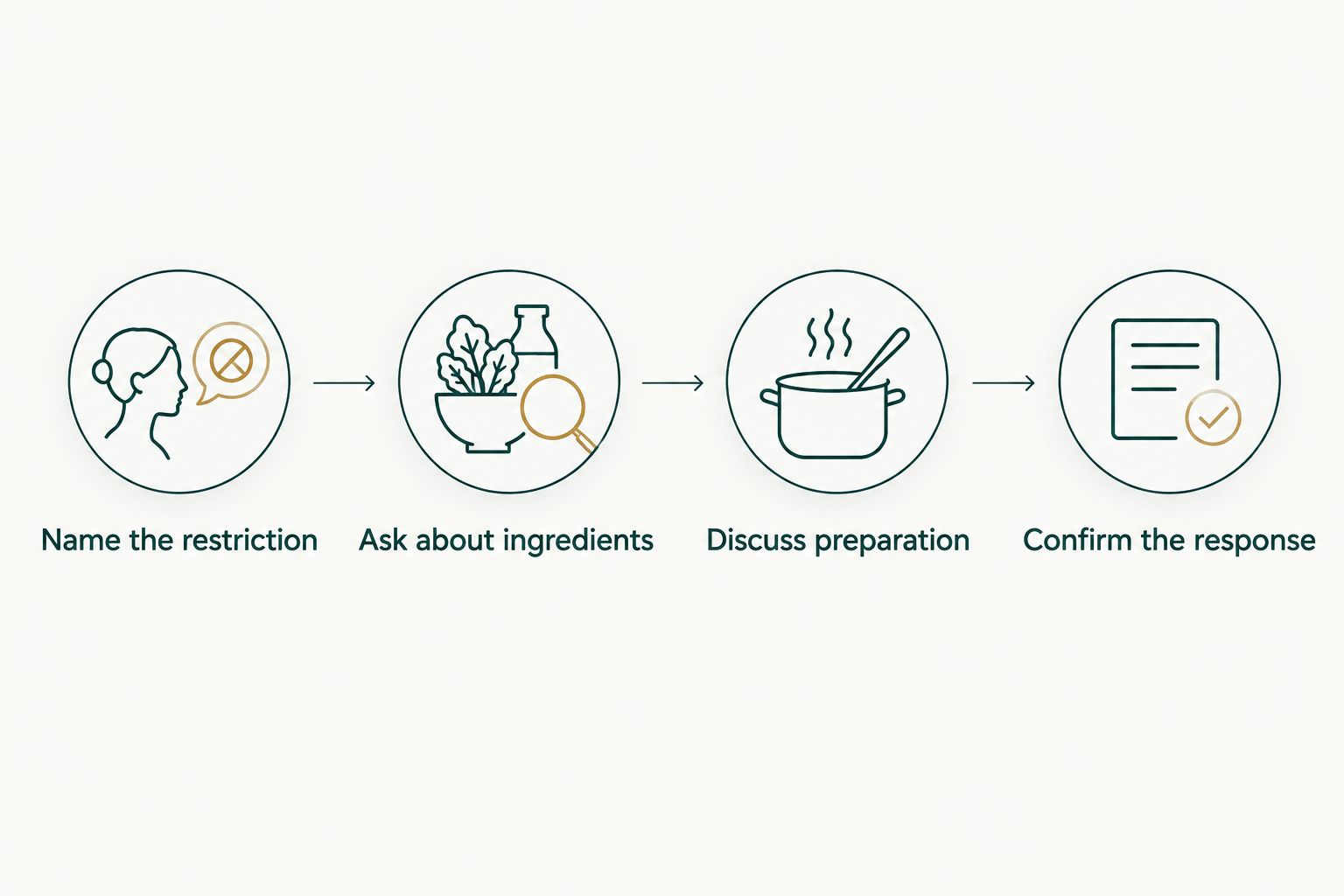
Use these steps to make the conversation useful:
- Name the restriction. State the exact food or ingredient you need to avoid. Explain whether the request concerns an allergy, celiac disease, another medical restriction, or a personal dietary choice.
- Ask about ingredients. Include sauces, dressings, garnishes, and other components rather than focusing only on the main item.
- Discuss preparation. For an allergy or medical restriction, ask about cross-contact through equipment, utensils, surfaces, or shared preparation.
- Confirm the response. Establish what the kitchen can accommodate, what it cannot accommodate, and what remains uncertain before you order.
A clear answer has boundaries. A statement that an ingredient can be omitted is narrower than confirmation about the remaining ingredients and preparation. Listen for that distinction rather than treating every modification as an allergy accommodation.
If the response does not resolve your needs, do not order on an assumption. Follow the dining guidance you have received from your healthcare professional.
ASK CLEARLY, BEFORE THE EVENING BEGINS
The most useful inquiry gives the restaurant enough detail to answer without guessing. Keep it brief, but name the issue precisely.
For a nut allergy, identify the specific nuts involved and state whether peanut avoidance is also necessary. For gluten-related restrictions, explain whether you have celiac disease, a wheat allergy, or a preference to avoid gluten; those descriptions do not mean the same thing.
Include the planned dining occasion, too. If you are arranging a date-night dinner, a birthday, or a private celebration, explain which guest needs the accommodation and whether the rest of the party has separate restrictions. Do not assume a response for an individual dinner also answers questions about a shared event menu.
Before sending your inquiry, check that it answers these questions:
- What exactly must you avoid?
- Is this an allergy, another medical restriction, or a dietary choice?
- Does cross-contact need to be addressed?
- Are there additional restrictions affecting the same guest?
- Which dining occasion are you planning?
These are planning details, not a request to share your medical history. Give the information needed to discuss food and preparation, then ask what the restaurant can confirm.
INGREDIENTS AND PREPARATION ARE DIFFERENT QUESTIONS
A menu description helps you choose what to ask about. It does not provide a complete account of every component or how a dish reaches the table.
Ask about the finished dish, not just its main ingredient. A request about a sauce should include its ingredients; a request about a garnish should also address the food beneath it. For allergy-related decisions, preparation belongs in the same conversation.
The distinction is especially useful when different guests use similar language for different needs:
| Dietary concern | Explain clearly | Ask before ordering |
|---|---|---|
| Peanut or tree-nut allergy | The specific allergens you must avoid | What ingredients and preparation practices need to be considered? |
| Celiac disease or gluten restriction | Whether the restriction is medical or preference-based | Can both ingredients and preparation meet your needs? |
| Milk allergy or lactose intolerance | Which condition applies and what you must avoid | Which components contain milk ingredients, and what can be changed? |
| Vegetarian or vegan preference | Whether you avoid meat, seafood, eggs, dairy, or other animal ingredients | Do sauces, stocks, dressings, and garnishes fit your requirements? |
| Multiple restrictions | The complete combination affecting the same guest | Can a single preparation meet all the requirements together? |
This table is a conversation guide, not a list of confirmed accommodations. Each request still needs an answer for the food you intend to order.
Avoid using a broad label when a precise description is available. For example, saying you avoid dairy does not tell the person taking the order whether you are describing an allergy, intolerance, or preference. Clear language gives the conversation a better starting point.
WHY DIETARY ACCOMMODATION DEPENDS ON THE REQUEST
Dietary questions become more useful when you move beyond asking whether a restaurant is generally allergy-friendly. Focus on the details that determine your own decision.
- The ingredient involved. Name the specific allergen or excluded ingredient rather than relying on a broad dietary category.
- The complete recipe. Ask about components that are not obvious from a short menu description, including sauces and garnishes.
- The preparation involved. Ingredient avoidance and cross-contact are separate matters; ask about both when your restriction requires it.
- The changes requested. Removing one component does not establish that every remaining component meets your needs.
- The combination of restrictions. A preparation discussed for one restriction still needs review if you also avoid other ingredients.
- The dining format. For a celebration or private gathering, discuss the intended menu and how your guest’s request will be handled.
Do not interpret this list as a description of the restaurant’s kitchen or procedures. Use it to ask focused questions and understand the limits of the answer you receive.
A useful conversation ends with a decision, not simply an acknowledgment. Know what has been confirmed before you proceed.
CAN I JUST ADD MY ALLERGY TO THE RESERVATION?
A reservation note is not confirmation of accommodation. Use the note to flag the restriction, then ask the restaurant directly whether your needs can be met.
Before dining, distinguish between a message being received and a request being reviewed. If you have only entered information into a booking field, you still need a clear answer about ingredients and preparation.
Repeat the restriction when ordering, even after an earlier conversation. Explain what was discussed and ask whether that guidance applies to the dish you are choosing. If the answer changes or remains unclear, pause rather than filling in the gaps yourself.
DOES REMOVING NUTS MAKE A DISH SUITABLE FOR A NUT ALLERGY?
Removing nuts does not establish that a dish is suitable for a nut allergy. You still need answers about other ingredients and potential cross-contact during preparation.
Ask whether nuts are part of a sauce, dressing, filling, or another component, rather than only a visible topping. Then discuss preparation separately. A dish without a visible nut garnish is not, by itself, evidence that your allergy requirements have been met.
Do not request that an allergen simply be picked off a finished plate and treat that as a resolved allergy concern. Explain the allergy and ask what preparation, if any, the kitchen can provide for your needs.
HOW SHOULD I PLAN A DATE NIGHT OR CELEBRATION?
Resolve the dietary question before building the evening around a particular meal. That gives you space to make a considered decision without the pressure of guests waiting at the table.
Siena suits diners seeking Mediterranean and Italian date-night dinners and celebrations. For a guest with an allergy or dietary restriction, that occasion still begins with an individual conversation about what they can eat.
If you are organizing for someone else, ask how they want their restriction communicated. Do not simplify an allergy into a preference or promise that a dish will be suitable before the restaurant has addressed the request.
For a group celebration, keep the details attached to the guest who needs them. Ask about that guest’s meal rather than assuming a menu chosen for the table answers every dietary question. Let the guest participate directly whenever possible.
Once the dietary discussion is complete, visit the Siena website for the reservation link. Treat booking the table and confirming the dietary request as connected tasks, not interchangeable ones.
Plan Your Dinner With Care
Visit the restaurant website for the reservation link after discussing your dietary requirements.
FAQ
Can Siena accommodate a severe nut allergy?
Get direct confirmation for your specific allergy before booking or ordering. Ask about the exact nuts involved, all dish components, and preparation; do not interpret a general willingness to modify food as confirmation that your needs can be met.
Should I mention a food allergy before making a reservation?
Yes—raise the allergy before making plans that depend on accommodation. A direct conversation gives you an opportunity to ask about ingredients and preparation before choosing whether to dine.
Is an allergy note on my reservation enough?
No—a reservation note does not establish that an allergy request can be met. Ask for a direct response and repeat the restriction when ordering.
Does a vegetarian dish also work for a nut allergy?
A vegetarian description does not establish suitability for a nut allergy. Ask about the specific ingredients and preparation of the dish you want to order.
Can I assume a gluten-free dish is suitable for celiac disease?
Do not assume a gluten-free description answers every question relevant to celiac disease. Discuss both ingredients and preparation, and follow the dining guidance provided by your healthcare professional.
What should I do if the restaurant cannot confirm an ingredient?
Do not order that dish on an assumption. Ask whether another preparation can be clearly assessed, and proceed only within the guidance you follow for your restriction.
How do I communicate dietary restrictions for a celebration dinner?
Identify each guest’s restriction and discuss the intended meal before finalizing arrangements. Keep allergies, medical restrictions, and preferences distinct, and let the affected guest clarify their needs directly.
ONE LAST THING
The most useful question is not simply whether an ingredient can be removed. It is whether the complete meal and its preparation meet your needs. That shift keeps the conversation focused on the decision you actually need to make.
For a warm evening together, settle the practical questions first. Confirm the restriction, understand the answer, and only then turn your attention to the occasion.